 narenana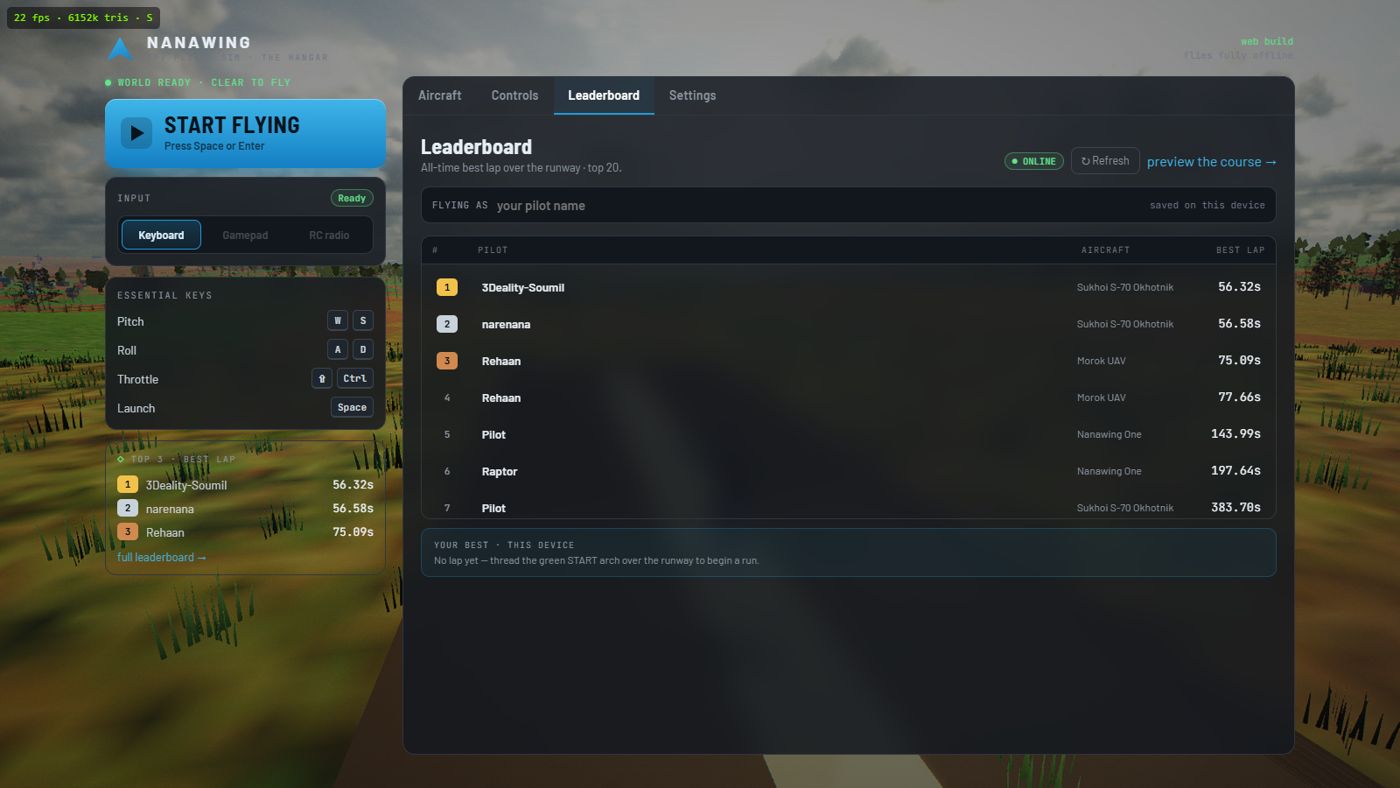
There is no race mode, on purpose
Most sims put a menu between you and the fun: pick a mode, pick a track, wait for a countdown. Nanawing deliberately doesn't. Press Space on the strip and you are in free flight, every single time — the same physics on either map, no gates between you and the sky. (New here? Start with the how-to-play guide.)
The race is an object in that world instead: a green START arch floats over the dirt airstrip that serves as home. Fly through it and a lap begins on the gate course. Don't, and the sim never mentions racing again — no popups, no nagging, no "would you like to try ranked mode?". You can put in an hour of low passes over the lake and the arch just sits there, glowing patiently. The race is an invitation, not an interruption.
Because it changes how you practice. In a moded game, racing is a decision you make in a menu. Here it's a decision you make at 120 km/h on the runway heading — bank a wingtip toward the arch mid-flight and you're suddenly on the clock, carrying whatever energy you arrived with. Your free-flight cruising and your race entries stop being separate activities.
Four courses, two maps
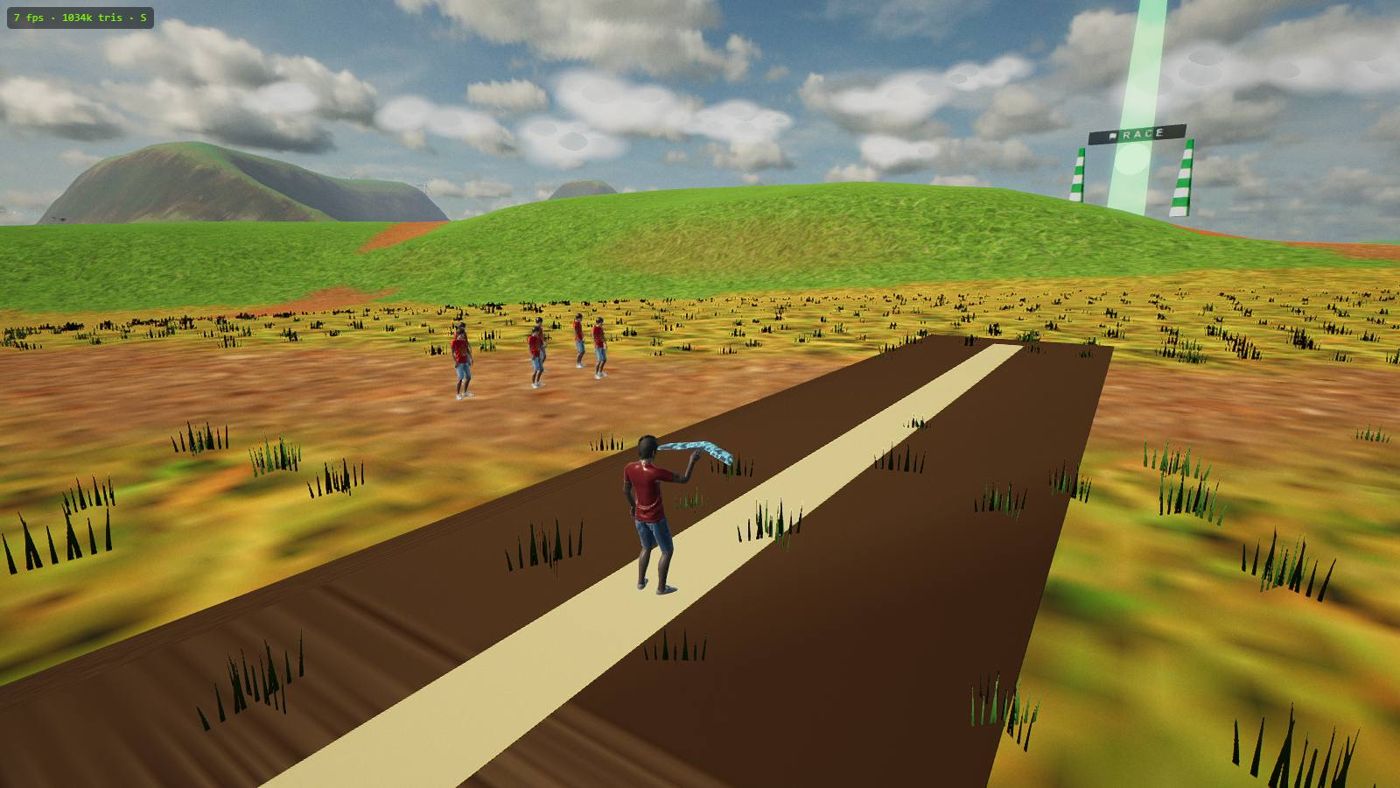
Cross the arch and a course of gates lights up, woven through the landmarks of the map itself. This isn't an abstract slalom dropped onto flat ground — every course threads real terrain you've already been exploring in free flight. Knowing the map is knowing the course, which is another quiet payoff of the no-modes design: every sightseeing flight is reconnaissance.
- Windmill Run (4.3 km, Island) — the grand tour: farmland, water and the windmill.
- River Run (8.1 km, Island) — down the river valley and back, the long one.
- Tunnel Run (5.1 km, Desert) — through a tunnel bored in a mesa and three hangars. Most people crash in the tunnel.
- Pyramid Run (5.7 km, Desert) — over a temple, under the bridge and down the river past the pyramids.
Each course keeps its own board for each aircraft, and the Desert boards are brand new — the top spots are still up for grabs.
Finish the lap and you get a time, and the time gets graded.
The medal ladder
Four tiers, fixed times, no rubber-banding. Every course has its own ladder, scaled to its length — here's Windmill Run, the original:
| Medal | Lap time | What it means |
|---|---|---|
| AUTHOR | under 55 s | You've matched the developer's own pace. Clean lines, no wasted altitude, full commitment. |
| GOLD | under 65 s | Fast, deliberate flying — you're carrying speed through gates instead of aiming at them. |
| SILVER | under 80 s | You know the course and you're flying it, not surviving it. |
| BRONZE | under 100 s | A completed lap with room to breathe. Everyone's first medal. |
The gap between BRONZE and AUTHOR is nearly a factor of two, and that's the point: the same course serves your first wobbly lap and your hundredth optimized one. Nothing changes but you. (AUTHOR on the others: River Run 1:45, Tunnel Run 1:19, Pyramid Run 1:28.)
Flying a faster lap
Carry speed, don't chase gates
The beginner instinct is to point the nose at each gate and correct late. The fast line is set up early: exit each gate already banked toward the next one, so the turn happens through the gate, not after it. A flying wing hates being slowed down and asked to accelerate again — every needless throttle chop costs you seconds on the following straight.
Bank, then pull
Wings turn by rolling. Roll with A/D first, then add back-pressure with S to carve — the coordinated turn the physics actually models. Yanking pitch while wings-level just balloons you above the course line; rolling without pulling slides you wide. The habit is covered in depth in the controls guide, and it's worth drilling in free flight before you care about lap times.
Pick the right wing — faster isn't automatically quicker
Press V to cycle the four aircraft, even mid-flight. The Sukhoi S-70 Okhotnik is by far the fastest thing in the hangar — 323 km/h top speed against the Nanawing One's 191 — but it stalls at 34 km/h versus 24, and it rolls at only 166°/s versus 241. These are simulator figures, with stall speeds calculated for level flight: the S-70 rewards a pilot who keeps it fast everywhere and punishes anyone who over-slows for a gate, mushing through the turn near stall while the docile Nanawing One would have simply carved it. Learn the course on the One; bring the S-70 when your lines are clean. Spectre offers a slower option at 100 km/h, with a 25 km/h level-flight stall and quick 344°/s roll; it competes on its own aircraft board. The full simulator spec sheets are in the aircraft guide.
R resets you to the strip instantly with a fresh battery, and the arch is right there overhead for another go. Laps are free. That's the whole economics of a simulator.
The leaderboard: named pilots, no accounts
Finish a lap and your time can go to the global all-time leaderboard — a board for every course and every aircraft, under the Leaderboard tab in the Hangar (pick the course and the wing above the results) and on the public leaderboard page. The Hangar shows each board as a podium for the top three, then the ranked field. The design is unusually humane for an online scoreboard:
- No accounts. You choose a pilot name once and it's saved on your device. No email, no password, no signup flow. The name is the identity.
- One row per pilot on each board, and it only ever improves. Your row is your personal best for that course and aircraft, full stop. A slow lap can never overwrite a fast one, which means every lap is safe to submit — there is no reason to hold back a time or fear "ruining" your entry.
- You always see where you stand. Even when your best lap is far down the field, the board shows you your own standing — you're racing the ladder, not staring at a wall of names faster than you.
The result is a board that rewards showing up. There's no meta, no seasons to grind, no smurfing incentive — just a list of names and the honest question of whether today's you can beat yesterday's you, and eventually whether anyone can beat the times at the top. (If you're curious how a leaderboard runs behind a game with no backend to speak of, the how-it's-built guide covers it.)
Offline honesty
Nanawing is an offline-first game: after the first load it flies entirely without a connection — including the race. The arch works, the gates work, your times and medals work, all of it, in a plane seat or a field with no signal. The one thing that genuinely needs the internet is this leaderboard, because a global scoreboard is by definition a conversation with a server. When you're offline the Leaderboard tab doesn't break or pretend: it tells you plainly that the board needs a connection, and it retries on its own when you're back online. No other part of the game is held hostage to it.
Which is the racing philosophy in one sentence, really: the race is always there, never in the way. The arch waits over the runway on both maps at sim.narenana.com — fly through it when you're ready.